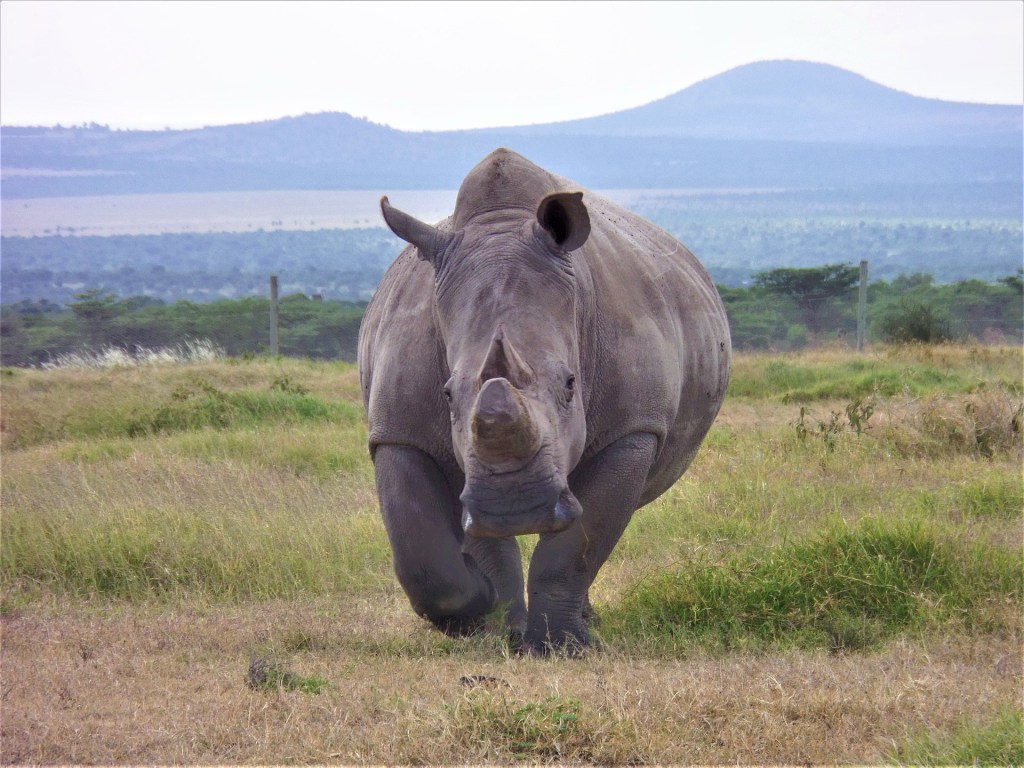
On a vast savannah at Kenya’s Ol Pejeta Conservancy, two females spend their days under 24-hour armed guard. Their names are Najin and Fatu. They are mother and daughter, and they are the last of their kind. When the world’s final male northern white rhinoceros, Sudan, passed away from age-related complications in March 2018, the subspecies became functionally extinct. Natural reproduction is now biologically impossible.
How humanity arrived at this desperate point is a story of colliding extremes: the unyielding biology of a magnificent mammal, the reckless vanity of the ultra-wealthy, and a historic, cutting-edge scientific race against the clock.
The Hubris of Privilege: Who Buys a Horn?
The tragedy of the northern white rhino was not driven by human survival, but by elite vanity. For decades, poachers slaughtered these animals to supply a lucrative black market concentrated heavily in Vietnam and China.
The tragic irony is that a rhino’s horn is made entirely of keratin—the exact same protein found in human fingernails and hair. Major medical authorities, including the World Federation of Chinese Medicine Societies, have officially declared that the horn has zero medicinal value. Yet, a shadow market persists, driven by a deeply rooted cultural psychological phenomenon: the hubris of privilege.
In high-society circles, a rhino horn is the ultimate “flex” of untouchable status. When a wealthy individual can easily buy any luxury car or mansion on earth, standard goods lose their meaning. An illegal, hyper-rare commodity becomes a premium luxury gift to buy political influence or flaunt immense wealth. In some elite circles, it is even used as a trendy, wildly expensive hangover “cure” after heavy drinking.
Furthermore, corrupt syndicates treat the animal’s demise as a game of financial speculation. They hoard horns, betting that as the species edges closer to total eradication, the vanishing supply will cause their illegal investments to skyrocket. To these buyers, a rhino is not a living creature; it is a stock option.
The Fallen Tycoons and the Shifting Narrative
For years, the wealthy consumers of this trade operated with total impunity, insulated by their money from the bloody reality on the ground. However, international law enforcement and NGOs have begun fighting back by targeting the one thing these elites care about most: their reputation.
Rather than just showing pictures of poached animals, modern anti-poaching campaigns weaponize public shame. In status-conscious societies, buying a rhino horn is increasingly reframed not as a sign of wealth, but as an embarrassing badge of ignorance.
Furthermore, the law is finally catching up to the masterminds. Prominent, wealthy businessmen who once believed they were above the law have faced dramatic public downfalls:
- The Antique Mogul: Zhifei Li, a wealthy Chinese entrepreneur catering to ultra-rich clients, was caught in an undercover U.S. federal sting operation after smuggling 30 raw rhino horns hidden inside porcelain vases. He was sentenced to nearly six years in a U.S. federal prison and forced to forfeit $3.5 million.
- The Logistics Kingpin: Nguyen Van Nam, known in the Vietnamese underworld as “Ah Nam,” built an arrogant financial empire trafficking wildlife. He was tracked down and sentenced to 11 years in prison after being linked to over $17 million worth of rhino horn and ivory.
- The Diamond Tycoon: In early 2026, Vietnamese diamond mogul Chu Dang Khoa was exposed after his network allegedly staged a fake armed robbery at a South African safari lodge to illegally traffic 98 stockpiled rhino horns.
Flipping the Financial Incentive
While elites face crackdowns abroad, a parallel revolution is happening on the ground in Africa. Historically, wealthy syndicates could easily bribe impoverished local villagers with a few hundred dollars to risk their lives poaching.
Today, the conservation model has completely flipped the economy. At places like Ol Pejeta, tourism revenue flows directly into the surrounding villages, funding local schools, healthcare clinics, and clean water projects. The local residents are hired as the park rangers, veterinarians, and caretakers.
When a community’s stable, legal livelihood depends directly on the safety of the wildlife, a living rhino becomes worth vastly more than a dead one. The community itself becomes the rhinos’ fiercest line of defense, shutting down the syndicates’ local recruitment pipelines.
The Frontier of Science: A 16-Month Race Against Time
Because Najin and Fatu have reproductive health issues and cannot carry a calf, saving the northern white rhino requires rewiring the laws of nature through the BioRescue Project.
Before the last males died, reproductive experts successfully extracted and cryopreserved semen samples from several bulls, including Sudan and another male named Suni. Today, scientists thaw this frozen sperm in specialized European laboratories to fertilize eggs harvested from Fatu using advanced IVF techniques. Because the genetic pool from these few males is limited, scientists are concurrently researching stem-cell technology to grow artificial sperm and eggs from the preserved skin tissues of 12 long-deceased rhinos, avoiding a dangerous genetic bottleneck.
As of 2026, this grand scientific endeavor has yielded 39 viable, frozen embryos. But who will carry them?
The answer lies with their closest relatives: healthy, wild-born southern white rhino females living in a secure enclosure at Ol Pejeta. Females like Arimet and Daly have been selected as surrogates. To ensure their bodies are perfectly ready for an embryo, scientists introduced a sterilized “teaser” male named Owuan; when he shows mating interest, it signals that a female’s hormone levels are perfectly aligned for implantation.
The stakes for these surrogates could not be higher. A white rhinoceros has an incredibly grueling gestational period of 16 months (roughly 480 to 548 days), resulting in just a single calf. Because mothers only give birth once every three to five years, each surrogate pregnancy is a massive, long-term biological investment.
A Legacy on the Horizon
As of 2026, scientists have performed six pure northern white rhino embryo transfers into these southern white surrogates. While a live birth has not yet been achieved, a previous proof-of-concept trial successfully sustained a 70-day pregnancy, proving that the surrogates’ bodies can host these lab-created embryos.
The anatomy of the northern white rhino’s near-extinction is a sobering reminder of what happens when human vanity runs unchecked. Yet, the ongoing battle to save them proves something else entirely: when modern science, community empowerment, and global justice unite, humanity is capable of moving mountains to undo the damage it has caused. Inside a liquid nitrogen tank in Europe, 39 embryos are waiting. Inside a sanctuary in Kenya, the surrogates are preparing. The countdown to a miracle is officially on.
Sources
- Ol Pejeta Conservancy
- The BioRescue Project
- WildAid
- TRAFFIC (The Wildlife Trade Monitoring Network)
- Wildlife Justice Commission


Leave a Reply